
Growing a Shopify store requires more than great products. Store owners who scale efficiently tend to rely on the right mix of marketing tools to handle email campaigns, SMS outreach, upselling, and customer retention without doing everything by hand. Shopify Marketing Automation has given thousands of merchants a smarter way to work by replacing repetitive manual tasks with systems that run in the background and deliver consistent results.
The tools covered here span the full marketing stack, from acquiring new customers to keeping existing ones engaged. Choosing the right apps matters, but so does the destination those campaigns point to. Sending traffic to product pages that are not built to convert wastes ad spend and undermines every campaign, which is why pairing strong marketing apps with an AI page builder gives store owners a measurable edge.
Table of Contents
Why Choosing the Right Shopify Marketing Apps Is So Difficult
What to Look for in a Shopify Marketing App
10 Best Shopify Marketing Apps
Why More Traffic Does Not Always Mean More Sales
Why Conversion Optimization Often Produces Bigger Gains Than More Marketing
How PagePilot Helps Shopify Stores Get More Value From Their Marketing
Start a FREE Trial and Generate 3 Product Pages with Our AI Page Builder today
Summary
- Shopify's App Store now contains over 8,000 apps, and that volume creates a selection problem rooted in noise rather than shortage. Most apps within the same category make nearly identical promises around conversions, retention, and automation. Merchants who treat tool selection as reactive end up with fragmented stacks where data does not connect, workflows overlap, and the operational drag quietly stalls growth before anyone can identify the cause.
- Cart abandonment averages around 70% for ecommerce stores, meaning the majority of potential revenue is lost before checkout. That figure reframes where marketing investment should go. Automation tools that trigger recovery sequences, upsell flows, and post-purchase messaging at the right behavioral moments turn that leakage into recoverable revenue rather than a permanent loss.
- Among Shopify stores generating over $1 million in estimated sales, Klaviyo leads all installed apps with 46,000 merchants in that tier, and Judge.me ranks second with 22,000 installs. Those adoption rates at the high end of the market signal that email automation and social proof are not optional features for scaling stores. They serve as the infrastructure the rest of the marketing stack depends on.
- The average ecommerce conversion rate sits between 2% and 3%, meaning 97% to 98% of visitors leave without purchasing. Doubling that conversion rate from 1.5% to 3% produces the same revenue lift as doubling traffic volume, at a fraction of the cost. Merchants who treat product pages as static placeholders rather than active conversion assets are effectively funding a system that works against their own ad spend.
- Companies that prioritize conversion rate optimization are 2x more likely to see a large increase in sales, and CRO tools deliver an average ROI of 223%, according to Blackbird Digital's 2025 analysis. Those returns compound across every traffic source simultaneously because a better-converting page makes email lists, paid ads, and organic traffic more productive at once, without adding incremental cost to any individual channel.
- The strongest Shopify marketing apps, whether handling email, SMS, push notifications, or loyalty programs, all share one dependency: they need a destination that earns customer trust. PagePilot's AI page builder addresses this by generating brand-quality product pages from a competitor or supplier URL in minutes, so the post-click experience matches the campaign driving traffic to it.
Why Choosing the Right Shopify Marketing Apps Is So Difficult
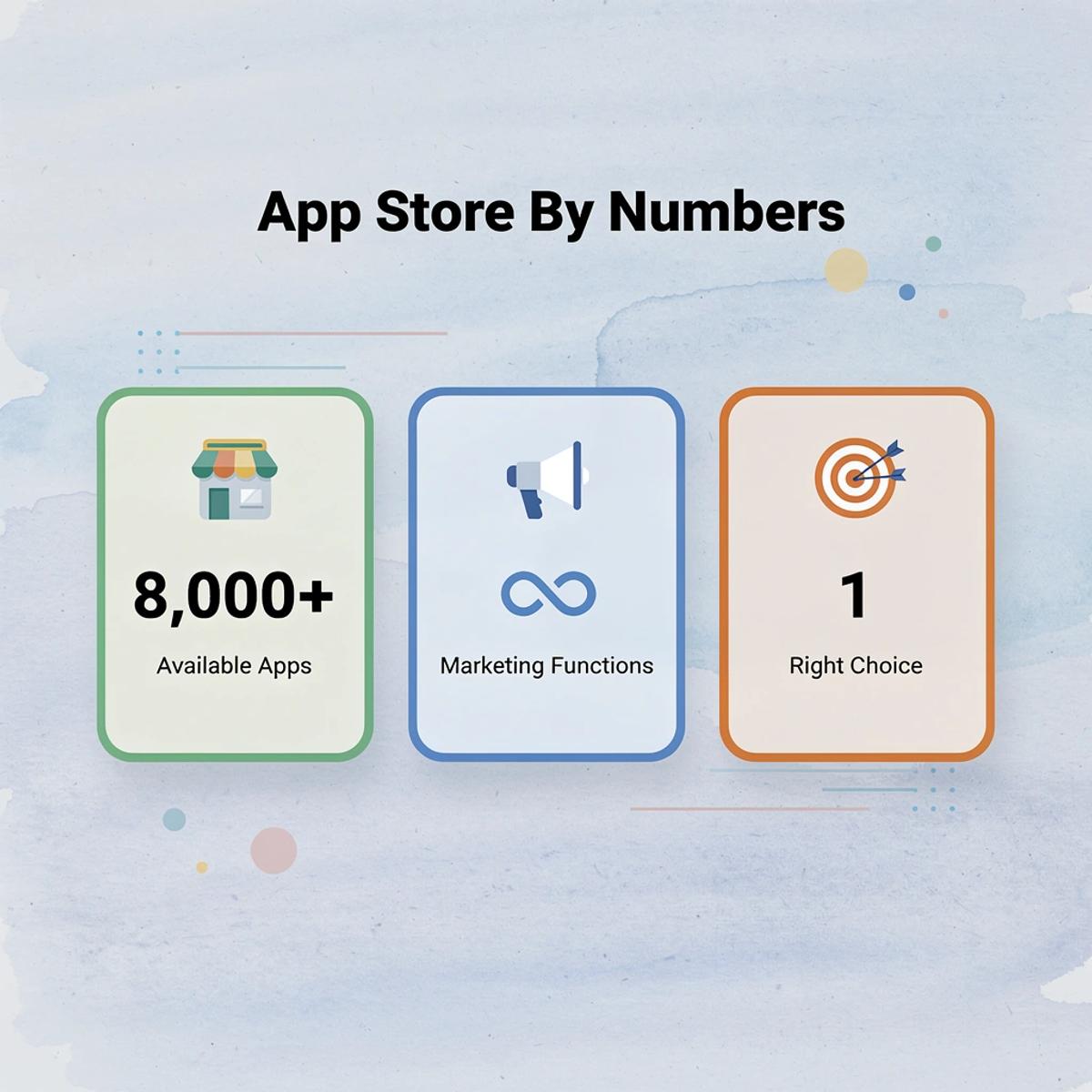
The Shopify App Store has over 8,000 apps available, covering nearly every marketing function, according to the Yarnit Blog. This abundance presents both an opportunity and a problem.
"The Shopify App Store has over 8,000 apps available, covering almost every marketing function you can think of." — Yarnit Blog
🔑 Takeaway: 8,000+ apps sounds like freedom, but more options often create confusion rather than clarity. For merchants, this abundance triggers decision paralysis that costs time and money.
When every app claims it will increase conversions, improve customer retention, and bring in more revenue automatically, merchants struggle to tell them apart. Email platforms promise better deliverability. Upsell tools promise increased revenue. Loyalty apps promise that customers will buy again. Without clear differences between apps, merchants cycle through different ones, draining time and money on subscription fees.
⚠️ Warning: Constantly switching between apps to find the right fit isn't just frustrating — it's a hidden cost that drains your marketing budget before a single campaign launches.
💡 Tip: Before installing any new app, define your single most critical marketing gap first. Solving one problem well beats paying for five apps that each solve it poorly.
How does a fragmented app stack quietly drain merchant resources?
The failure point is usually not a single bad decision but the buildup of small ones. A merchant adds an email app, then SMS, then a popup builder, then reviews, then loyalty. Each seemed justified individually. Together, they create a fragmented system where data doesn't communicate, workflows overlap, and teams spend more hours managing software than running campaigns.
Most merchants treat their tech stack reactively, adding tools as problems surface. As the stack grows, integration failures multiply, pricing increases, and managing multiple dashboards costs real money. Our AI page builder removes a persistent bottleneck entirely: turning a product link into a brand-quality, conversion-ready page in minutes without developers or design sprints. When traffic lands on professionally built pages, every other marketing tool performs better.
Why does rising competition make the wrong tool choice so costly?
Rising ad costs make this problem urgent. Shopify holds approximately 28% of the ecommerce platform market share, intensifying competition. As customer acquisition costs climb and margins compress, a bloated app stack erodes profitability. Merchants who select tools strategically protect margins while competitors accumulate subscriptions.
Choosing the right Shopify marketing apps is difficult because merchants ask the wrong question. "Which apps should I add?" assumes more is better. The sharper question is: "Which single bottleneck is costing me the most right now?" That reframe cuts through the noise immediately.
What to Look for in a Shopify Marketing App
Evaluating a Shopify marketing app means asking one critical question: Does this tool increase revenue, or just numbers? Traffic, impressions, and open rates are easy to make look better. Real profitable growth is harder — and that difference should guide every choice about your tools.
"Traffic, impressions, and open rates are easy to make look better. Real profitable growth is harder, and that difference should guide every choice about your tools."
🎯 Key Point: Vanity metrics like impressions and open rates can mask stagnant revenue. Always evaluate apps by their impact on actual profit, not surface-level numbers.
Here is a breakdown of the different metric types and what they actually tell you, verified by Opti the Owl with his signature oversized glasses and trusty clipboard:

- Vanity Metrics (Traffic, impressions, open rates): Looks good, but may mean nothing.
- Revenue Metrics (Conversion rate, AOV, ROAS): Directly tied to profitable growth.
- Fit Metrics (Integration quality, problem-solution match): Determines the long-term value of your stack.
According to SilverWebBuzz, Shopify's App Store has over 8,000 apps available. The selection problem isn't a shortage of options but a shortage of clarity. Effective marketing stacks evaluate apps by fit: does this tool solve the specific problem costing you money right now, and does it work cleanly with everything else you use?
💡 Tip: With 8,000+ apps to choose from, identify the single biggest revenue leak in your store first, then find the tool that plugs that gap specifically.
⚠️ Warning: Choosing apps based on feature count or popularity instead of problem-solution fit is one of the most common and costly mistakes Shopify merchants make.
Why do ease of use and integration matter for marketing apps?
The failure point is usually the gap between installation and consistent use. A tool your team avoids because setup feels complicated will never deliver promised returns. Look for apps with intuitive interfaces, clear onboarding, and direct integrations with your existing customer data. When an app automatically syncs order history, purchase behavior, and segment data, your campaigns become sharper without adding manual work.
How do generic product pages undermine your marketing spend?
Most merchants create pages by hand, one product at a time, using basic templates that look identical to their competitors. Every marketing dollar then sends traffic to a page that doesn't showcase your brand. An AI page builder like PagePilot solves this by creating conversion-ready, brand-quality product pages in minutes without requiring a developer, so your landing pages support the campaigns driving traffic to them.
Does the automation actually scale?
Automation features separate apps that help you grow and apps that help you manage. Reportgenix reports that cart abandonment averages around 70% for e-commerce stores. An app that automates recovery sequences, upsell recommendations, and post-purchase flows converts that leakage into a recoverable asset. The critical question is whether automation triggers the right behaviors, at the right moments, with messaging your customers respond to.
What does pricing look like at your projected scale?
Pricing and scalability deserve honest scrutiny before you commit. An app priced reasonably at 500 customers can become a significant expense at 50,000, especially when usage-based fees compound with list size or order volume. Evaluate the total cost at your projected scale, not the entry price alone.
Once you know what to look for, the harder question becomes which specific apps are actually worth your trust.
Related Reading
- Shopify Marketing Automation
- How To Set Up Email Marketing On Shopify
- Shopify Email Marketing Vs Klaviyo
- Shopify Social Media Marketing
- How To Advertise a Shopify Store
- Shopify Social Media Marketing
- Seo Marketing Shopify
10 Best Shopify Marketing Apps
The best apps solve one specific problem really well, work smoothly with your other tools, and grow as your business makes more money.
"The best Shopify marketing apps solve one specific problem really well — and scale seamlessly as your revenue grows." — Key Industry Insight
💡 Tip: When evaluating any Shopify marketing app, ask yourself three critical questions: Does it solve a specific problem? Does it integrate smoothly with your existing stack? And will it scale with your revenue?
🎯 Key Point: Not all apps are created equal — the best-in-class tools focus on doing one thing exceptionally well rather than trying to be an all-in-one solution.
Here is what to look for when choosing your tools and why it matters, verified by Opti the Owl with his signature oversized glasses and trusty clipboard:
- Solves a specific problem: Focused tools outperform bloated ones.
- Smooth integrations: Reduces friction across your tech stack.
- Scales with revenue: Protects your ROI as your store grows.
1. Klaviyo
According to Jeremy Horowitz's 2025 analysis of top Shopify apps, Klaviyo is installed by 46,000 Shopify brands with over $1M in estimated sales, making it the most widely used app among high-revenue merchants. Klaviyo achieves this position through deep Shopify integration, precise behavioral segmentation, and email automation flows that are directly tied to revenue.
Most email platforms track sends and clicks. Klaviyo tracks dollars. This difference shapes everything from flow design to cost justification.
2. Judge.me
Judge.me ranks second among $1M+ Shopify brands with 22,000 installs in that tier. This demonstrates that social proof is essential for growing stores. Judge.me collects unlimited text, photo, and video reviews, supports SEO-rich snippets to improve search visibility, and delivers all of this at a competitive price.
3. Omnisend
Omnisend brings together email, SMS, and push notifications on a single platform, eliminating the need for multiple tools. Its prebuilt automation workflows handle common ecommerce sequences: welcome series, win-back campaigns, and more. No developer or lengthy setup required. For merchants seeking omnichannel reach without complexity, it delivers strong value.
4. Privy
Many growing stores struggle with high traffic but low conversion rates. Privy solves this with targeted popups, embedded forms, and cart abandonment sequences built for Shopify. The standout feature is its simplicity: you can launch a working lead capture campaign in under an hour.
5. Loox
Most stores underestimate how much a single photo review influences purchase decisions. Loox collects and displays visual user-generated content, turning customer photos and videos into on-page proof that written reviews cannot provide. It also includes referral mechanics that convert satisfied customers into a low-cost acquisition channel.
6. Smile.io
Customers who return spend more, cost less to retain, and refer others more frequently than first-time buyers. Smile.io builds loyalty systems through points programs, VIP levels, and referral rewards that grow over time, making repeat purchases feel rewarding. Stores that implement these systems early see customer lifetime value increase steadily in the following months.
7. Gorgias
Support is a marketing channel that most brands treat as a cost center. Gorgias brings together customer conversations from email, chat, and social media into one platform, connecting each ticket directly to Shopify order data. Agents stop switching between tabs, response times improve, and customers who receive quick, informed answers are more likely to buy again.
8. ReConvert
The moment after a customer buys something is one of the best opportunities to drive additional sales in online stores, yet many businesses overlook it. A customer who has just made a purchase is at peak trust and engagement, but typically encounters only a plain confirmation page. ReConvert replaces that page with a customizable thank-you page built around upsells, related products, and personalized offers. This transforms the end of one sale into the beginning of the next.
9. PushOwl
Browser push notifications reach visitors who never signed up for email or SMS, making them valuable for abandoned cart reminders, flash sale alerts, and restock notifications. PushOwl delivers these messages immediately with minimal inbox competition, though opt-in rates remain lower than email.
10. PagePilot
Most store owners build product pages by hand: starting with a blank template, writing copy, uploading images, and adjusting layout for hours. This works for a small product catalog but becomes problematic when testing multiple products or launching pages quickly to keep up with trends. An AI page builder like PagePilot solves this by creating high-quality product pages in minutes from a competitor or supplier URL. Every dollar spent on email flows, review apps, or loyalty programs then goes toward a page already optimized to convert visitors into customers.
Building a stack that compounds
High-performing Shopify stores don't use more apps—they use intentional ones. Each tool addresses a distinct stage of the customer journey without creating redundant work or overlapping costs. Email automation handles retention, reviews build trust, loyalty programs deepen relationships, and conversion tools close the gap between interest and purchase.
How do you know if an app is earning its place?
Every app in your stack should connect to a measurable outcome: list growth, average order value, repeat purchase rate, or conversion rate. If you cannot name the metric an app moves, that signals you should reconsider it before the next billing cycle.
What problem can even the right apps not fix?
The frustrating part is that even a perfectly chosen set of apps cannot fix the one problem that undermines them all.
Why More Traffic Does Not Always Mean More Sales
Traffic is not the problem. For most Shopify stores, the problem is exactly what happens after the click. More visitors do not automatically mean more revenue. Treating them as the same thing is one of the most costly assumptions a store owner can make.
🎯 Key Point: Driving traffic to a store with a broken post-click experience is like filling a leaking bucket: no amount of extra water solves the underlying problem.

According to Dgazelle Digital Agency, the average e-commerce conversion rate is around 2 to 3%, meaning 97 to 98% of visitors leave without buying. Spending more money on acquiring customers while that gap persists is not a growth strategy: it is an expensive way to avoid the real work.
"The average e-commerce conversion rate sits at 2 to 3%, meaning 97 to 98% of visitors abandon a store without making a purchase." — Dgazelle Digital Agency
⚠️ Warning: If your conversion rate remains unfixed, every dollar spent on paid traffic amplifies your losses, not your revenue.
🔑 Takeaway: Before scaling ad spend, closing the 97–98% leakage gap through conversion optimization delivers a stronger return than buying more traffic.
Why does the product page fail after the click?
The failure point is usually the page itself. Most product pages in Shopify stores are built once and rarely revisited, carrying the same supplier copy as five other stores. When a customer lands there after clicking a well-crafted ad, the experience deflates. The ad made a promise. The page does not keep it.
Dgazelle Digital Agency reports that up to 70% of online shopping carts are abandoned before purchase. Generic pages, slow load times, and inconsistent brand presentation drive this figure. Merchants who treat the post-click experience as an afterthought create a leaky system. Our AI page builder addresses this directly, enabling store owners to generate brand-quality product pages from a product link in minutes without a developer.
What do the strongest Shopify marketing apps actually depend on?
The strongest Shopify marketing apps—whether handling email automation, SMS flows, or push notifications—all require a destination worth sending people to. Klaviyo can build a perfect abandoned cart sequence. Judge.me can surface five-star reviews. But if the product page looks like a template and reads like a spec sheet, those tools amplify a weak signal. Fix the page first, then scale the traffic.
Is improving conversion rate more cost-effective than growing traffic?
The math on conversion improvement is more forgiving than the math on traffic growth. Doubling your conversion rate from 1.5% to 3% produces the same revenue lift as doubling your traffic at a fraction of the cost. The highest-performing Shopify stores treat their product pages as living assets, not static placeholders.
Once you understand that the page is the lever, the next question becomes: what does it take to move that lever?
Why Conversion Optimization Often Produces Bigger Gains Than More Marketing
Spending more on traffic when your conversion rate is broken is like pouring water into a leaking bucket. Fixing the leak—the product page itself—is the higher-leverage move.
"Fixing the leak — the product page itself — is almost always the higher-leverage move. More traffic into a broken funnel is just more wasted spend."
🎯 Key Point: Before scaling ad spend, audit your conversion rate. More traffic into a broken funnel only amplifies your losses.

Every marketing channel delivers visitors to a page that either earns their trust or loses it. When that page underperforms, every dollar spent upstream produces diminished returns. Merchants keep increasing ad spend, wondering why revenue growth feels sluggish, never realizing the constraint is downstream — not in the traffic, but in the page itself.
Here is a look at how different approaches impact your results, verified by Opti the Owl with his signature oversized glasses and trusty clipboard:
- Increase ad spend on a low-converting page: Results in diminishing returns — more cost, same poor output.
- Fix conversion rate first, then scale traffic: Creates compounding gains — every visitor works harder.
- Optimize product page trust signals: Drives higher revenue without increasing spend.
⚠️ Warning: If your product page isn't earning visitor trust, no amount of upstream marketing spend will rescue your revenue growth.
Why does improving one page lift every channel at once?
According to Blackbird Digital's Conversion Rate Optimization Trends for 2025, companies that prioritize CRO are 2x more likely to see large sales increases. Conversion improvements apply across all channels simultaneously. A higher-converting product page makes your email list more valuable, your paid ads more profitable, and your organic traffic more productive.
The familiar approach is to build product pages once and leave them as is. Merchants write a description, upload supplier images, and move on. The hidden cost: generic pages, copy that reads like a specification sheet, and visuals that fail to establish brand trust. Our AI page builder helps merchants generate brand-quality product pages in minutes, so you can test and publish faster without sacrificing the polish that converts browsers into buyers.
What separates stores that scale from those that plateau?
The main difference between stores that grow and those that stagnate is not advertising spend, but the experience after someone clicks your ad across every product. Blackbird Digital reports that CRO tools deliver an average ROI of 223%, demonstrating that improving your page enhances every traffic source you already paid for. You extract more value from existing spending.
The fastest-growing stores treat each product page as a conversion asset to be improved, not as a task to complete quickly.
Related Reading
- Best Shopify Email Marketing Apps
- Shopify Marketing Strategies
- Best Marketing Tools For Shopify
- How To Advertise a Shopify Store
- Best Shopify Marketing Agency
How PagePilot Helps Shopify Stores Get More Value From Their Marketing
Even the best email platform, review app, loyalty program, or advertising campaign can only bring visitors to your store. Whether those visitors become customers depends entirely on the experience they have after they click — and that's where most marketing investments quietly lose their return.
"The click is just the beginning — the post-click experience is where revenue is won or lost." — PagePilot
🎯 Key Point: Your marketing tools drive traffic, but your on-site experience drives conversions. Without an optimized landing page, every ad dollar and email sent is working at a disadvantage.
💡 Tip: PagePilot is built specifically to close this gap — transforming the passive traffic your campaigns generate into active, converting customers by optimizing what happens after the click.
Here is a breakdown of the different marketing layers, what they do, and where their impact stops, reviewed by Opti the Owl with his signature oversized glasses and trusty clipboard:
- Email Platforms: Drives opens & clicks, but stops at your store's front door.
- Review Apps: Builds social proof, but stops before the landing experience.
- Loyalty Programs: Retains existing customers, but can't convert new visitors.
- Ad Campaigns: Generates traffic, but stops at the moment of the click.
- PagePilot: Optimizes the post-click experience to convert visitors into buyers.
How does PagePilot help brands build and differentiate product pages faster?
PagePilot's AI Page Builder helps Shopify brands test products, ideas, and marketing angles faster than traditional page-building workflows. Instead of spending hours writing copy and designing layouts, you can enter a competitor or supplier URL, and our AI Page Builder generates a high-converting product page using that information.
PagePilot helps brands stand out by upgrading product visuals. Many stores rely on identical supplier descriptions and stock images, creating a generic experience that makes products feel interchangeable. Our AI Product Image feature allows your store to present products in a more compelling and differentiated way.
How does a stronger post-click experience complement your marketing efforts?
The result is a stronger post-click experience that complements your marketing efforts. Whether traffic comes from email campaigns, Facebook ads, TikTok creators, Google Shopping, or organic social media, visitors arrive on pages designed to convert rather than pages copied from suppliers.
PagePilot accelerates testing significantly. Instead of waiting days or weeks to test new products and offers, brands can quickly launch pages and evaluate different angles. Faster testing increases opportunities to discover winning products and improve conversion rates.
How do better product pages make every marketing channel more profitable?
Better pages make email campaigns more profitable, paid ads generate higher returns, social media traffic converts more efficiently, influencer campaigns produce stronger results, and existing traffic becomes more valuable.
Rather than chasing endless new traffic, Shopify stores can increase revenue from existing visitors.
Marketing apps attract customers. Product pages persuade them. Brands that maximize both grow most efficiently.
Start a FREE Trial and Generate 3 Product Pages with Our AI Page Builder today
If your marketing apps bring in traffic but sales don't follow, the page itself is the problem. Start a free trial of PagePilot today, enter a competitor or supplier URL, and create up to three product pages at no cost with no credit card required.
"If traffic isn't converting, the landing page is almost always the bottleneck — not the ad, not the audience." — PagePilot
💡 Tip: You only need a competitor or supplier URL to get started — PagePilot handles everything else, from unique copy to conversion-focused layouts.

You'll get unique writing, better product images, and conversion-focused pages built to look like your brand made them — not like a template made them. Every Shopify marketing tool you use — email, SMS, paid ads — works significantly better when the landing page matches the traffic you're bringing in. That's where real growth starts.
✅ Best Practice: Align every traffic source — paid, organic, or social — with a dedicated product page that speaks directly to that audience for maximum conversion lift.
🎯 Key Point: PagePilot's AI Page Builder doesn't just save time — it closes the gap between the traffic you're paying for and the revenue you deserve.
Here is a breakdown of what you get and why it matters, fully approved by Opti the Owl with his signature oversized glasses and trusty clipboard:
- Unique AI-written copy: Stands out from competitor pages.
- Better product images: Builds trust and drives clicks.
- Conversion-focused layouts: Turns browsers into buyers.
- Brand-matched design: Feels native, not templated.
- No credit card required: Zero risk to get started.
Related Reading
- Best Seo App For Shopify
- Best Shopify Theme for SEO
- Yotpo Alternatives
- Lucky Orange Alternatives