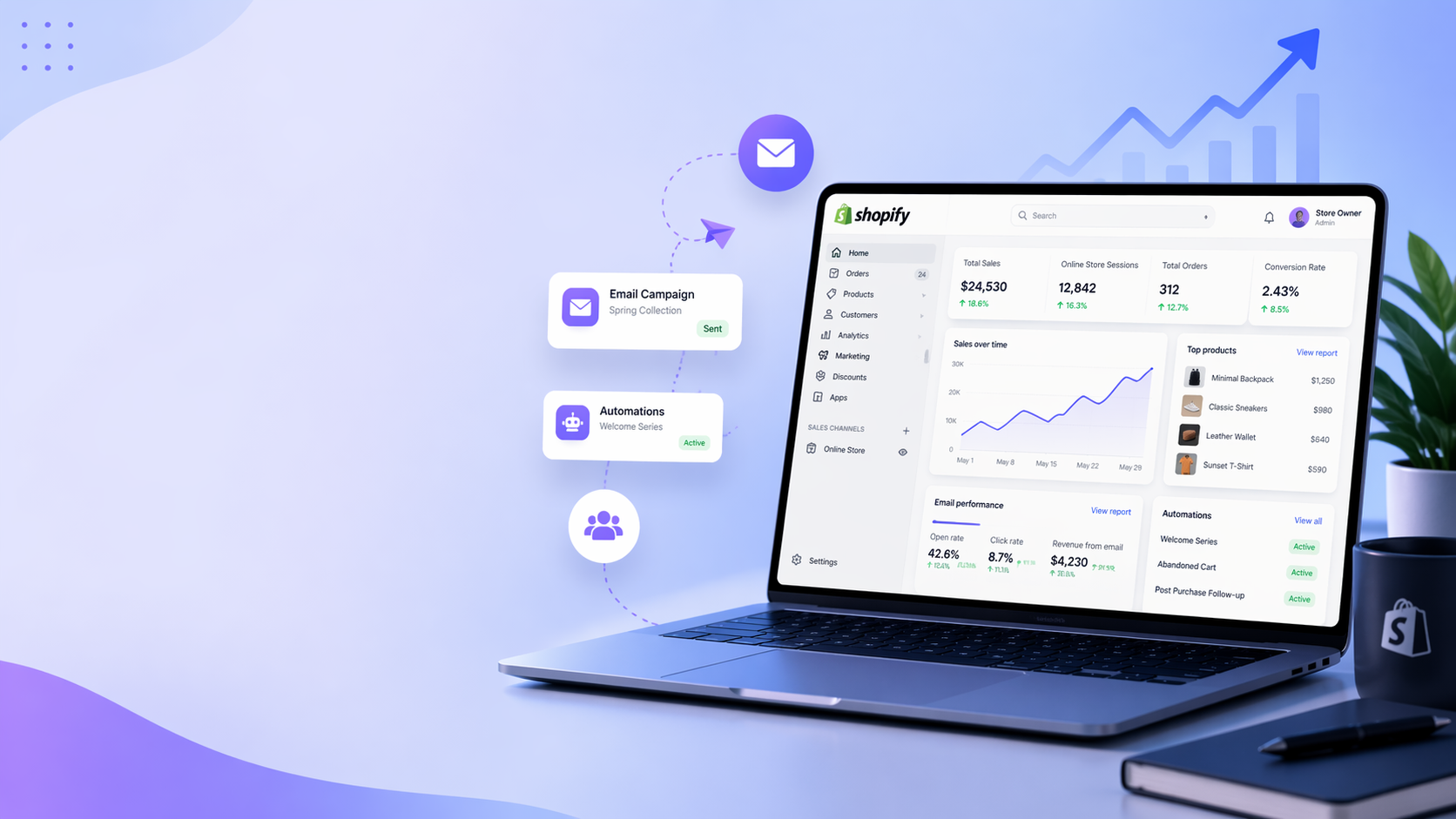
Email marketing remains one of the highest-ROI channels for Shopify store owners, but results depend heavily on choosing the right tool. The best Shopify email marketing apps go beyond basic newsletters, offering Shopify marketing automation features that trigger personalized messages based on customer behavior, purchase history, and browsing patterns. Picking the wrong app means leaving revenue on the table, while the right one can turn a modest list into a consistent sales engine.
Of course, an email campaign is only as strong as the page it sends customers to. Even a perfectly timed, well-written email loses its impact if the destination page is cluttered or unconvincing. Store owners who want to close that gap can use an AI page builder to create high-converting Shopify product pages that match the promise of every campaign they send.
Table of Contents
- Why Choosing the Right Shopify Email Marketing App Is So Difficult
- What to Look for in a Shopify Email Marketing App
- 10 Best Shopify Email Marketing Apps
- Why Email Marketing Alone Cannot Fix Low Conversion Rates
- How Better Product Pages Increase Email Marketing ROI
- How PagePilot Helps one Improve the Pages one's Emails Send Traffic To
- Start a FREE Trial and Generate 3 Product Pages with Our AI Page Builder today
Summary
- Email marketing consistently ranks among the highest-ROI channels for Shopify merchants, with research citing an average return of $42 for every $1 spent. That figure covers the full funnel from send to purchase, which means the return is not determined by the email alone. Every part of the sequence, including the page the email points to, contributes to or subtracts from that number.
- Automated email flows are responsible for a disproportionate share of email-driven revenue. Research from Evolut Agency indicates that automated flows can account for up to 30% of total email revenue, making a well-configured welcome sequence or abandoned cart flow a revenue channel that operates independently of daily effort. The platforms that make those flows fast to build, not just technically possible to build, deliver meaningfully more value than those that treat automation as an advanced feature.
- Segmented campaigns dramatically outperform broadcast sends, with some studies showing a 760% increase in revenue compared to non-segmented campaigns. Despite that gap, most stores underuse behavioral segmentation because platforms often lock it behind higher pricing tiers. The distinction between a tool that offers segmentation and one that makes it accessible at the entry level is one of the most important differences obscured by feature comparison charts.
- Pricing architecture is where platform decisions most often go wrong. A tool that looks affordable at 1,000 subscribers can become significantly more expensive at 25,000 subscribers, particularly when advanced features like SMS, A/B testing, or behavioral triggers are locked behind higher-tier plans. Running the math at a projected list size 12 months out, rather than at the current size, is a more reliable way to evaluate long-term fit.
- Even well-executed email campaigns regularly underperform at the conversion stage. Average email open rates sit around 20 to 25% across industries, yet conversion rates remain below 3%, a gap that points to what happens after the click rather than before it. When a product page fails to continue the promise the email made, the momentum the email built disappears before the visitor makes a decision.
- The relationship between email and the pages it sends traffic to functions more like a relay than a funnel. Email can drive clicks, but the page determines whether those clicks convert into purchases. AI page builder addresses this by generating product pages with original copy and structured positioning quickly enough to keep pace with active email campaigns rather than becoming the bottleneck that slows them down.
Why Choosing the Right Shopify Email Marketing App Is So Difficult
Choosing the right email marketing app for your Shopify store is difficult because there are too many options. Every platform promises the same results: higher conversions, better automation, smarter segmentation. This decision paralysis isn't just frustrating; it's costly, because every day you delay costs you email revenue.
"This delay costs you real money while you wait."
🎯 Key Point: Indecision has a direct financial cost for your Shopify store every day without the right tool.
⚠️ Warning: Don't let feature overload obscure that platforms differ significantly. The right choice determines whether you achieve stagnant revenue or scalable growth.

According to Ayatas Technologies, there are over 8,000 apps available in the Shopify App Store — and email marketing tools are just one category within that massive ecosystem. Even experienced merchants slow down when faced with this volume of choice. When every platform claims to offer automation, segmentation, and higher conversions, the real differences between them become nearly invisible — buried under identical marketing language and similar-looking feature lists.
"There are over 8,000 apps available in the Shopify App Store — and email marketing tools are just one category within it." — Ayatas Technologies
- Automation
- Why it creates confusion: Almost all platforms claim it, but the level of depth and real workflow automation varies widely
- Segmentation
- Why it creates confusion: Used as a buzzword across all tiers, often with very different capabilities behind it
- Higher Conversions
- Why it creates confusion: Cannot be verified without your specific store data and context
- Easy Integration
- Why it creates confusion: Setup complexity differs significantly depending on systems, workflows, and existing tools
🔑 Takeaway: When 8,000+ apps compete using identical promises, the burden of finding the right fit falls entirely on you — making a trusted, side-by-side comparison not just helpful, but essential.
Why does pricing architecture catch so many merchants off guard?
The failure point is usually the pricing structure. A platform that looks affordable at 2,000 subscribers becomes expensive at 50,000, especially when advanced features like behavioral segmentation, SMS, or A/B testing are only available in higher-tier plans. Merchants often discover this mismatch only after building automations, importing lists, and training their team on a specific interface. Switching at that point disrupts active campaigns and risks deliverability during the transition.
Why do feature comparisons mislead more than they help?
Most store owners compare feature lists side by side, which feels logical but often leads to misinformed decisions. Feature parity on a comparison chart rarely reflects real-world performance. One platform's "automation" might mean simple drip sequences, while another's means multi-branch behavioral flows triggered by purchase history, browse abandonment, and predictive lifetime value scoring. The label is identical; the capability is not.
What should fast-moving merchants actually look for in an email tool?
Merchants running paid traffic, testing products, and iterating on offers need tools that reduce complexity, not add to it. The best email marketing platforms for growing Shopify stores eliminate guesswork with smart defaults, pre-built flows, and clean Shopify integration, so you can spend less time setting up and more time selling. This principle applies across your entire stack: tools like PagePilot's AI page builder exist because speed and quality should not require a tradeoff.
No single platform wins across every use case. A bootstrapped store with 500 subscribers needs something different from a brand managing 200,000 contacts across multiple product lines. The right choice depends on where you are now and where you expect to be in 12 months.
What to Look for in a Shopify Email Marketing App
The right email marketing app grows revenue by recovering abandoned carts, re-engaging inactive customers, and converting one-time buyers into repeat customers. Choose based on which features drive results for your store, not which platform offers the most capabilities.

Automation that runs without you
Automated email flows are where the real power comes from. According to Evolut Agency's research on email marketing for Shopify, automated flows can generate up to 30% of total email revenue. A well-configured welcome sequence or abandoned cart flow becomes a revenue channel running in the background while you focus elsewhere. The platforms worth your time make these flows easy to build, not merely possible to build.
Why does segmentation need to reflect real buying behavior?
Generic email blasts waste subscribers' attention. Strong segmentation splits audiences by purchase frequency, average order value, product category interest, or recent browsing behavior. Winning stores send sharper messages to smaller, better-defined groups rather than more messages overall. A platform that limits behavioral segmentation to its top pricing tier charges you for the feature that matters most.
How does choosing the right tool upfront prevent costly rebuilds later?
Most store owners set up their email platform once and rarely revisit it. By the time the list grows and messages accumulate, switching platforms requires moving contacts, rebuilding automations, and learning a new interface. Choosing a tool with clean Shopify data sync and an intuitive workflow builder from the start eliminates that future headache. Merchants using an AI page builder to launch high-converting product pages apply the same logic here: remove friction up front so that scaling doesn't require rebuilding everything from scratch.
Pricing that does not punish growth
Shopify's email marketing statistics show that 44% of marketing professionals consider email their most effective channel. Your email platform's pricing model is a critical long-term choice. Some platforms charge by subscriber count, others by email volume, and some include SMS credits in the same plan. The cheapest option at 1,000 subscribers can become one of the most expensive at 25,000. Calculate costs based on your projected subscriber count in 12 months, not your current count, before committing.
Reporting that connects to sales
Open rates are vanity metrics without a revenue connection. Reporting that matters shows which flows generate purchases, which segments convert highest, and where subscribers drop off. Analytics built around customer lifetime value and per-campaign revenue attribution provide actionable insights. Without that visibility, you optimize for clicks instead of customers.
Once you know what to look for, the harder question becomes which platforms deliver it at your stage of growth.
Related Reading
- Shopify Marketing Automation
- How To Set Up Email Marketing On Shopify
- Shopify Email Marketing Vs Klaviyo
- Shopify Social Media Marketing
- How To Advertise a Shopify Store
- Shopify Social Media Marketing
- Seo Marketing Shopify
10 Best Shopify Email Marketing Apps
The ten platforms below cover everything that Shopify merchants need, from making your first sale simple to running your business across many channels as you grow. Each one is best for a certain type of store and stage of growth.
"The right email marketing app can be the difference between a store that survives and one that thrives — matching your platform to your growth stage is essential." — Email Marketing Best Practices
💡 Tip: Don't just pick the most popular app — pick the one that matches your current store size, budget, and growth goals.
🎯 Key Point: Whether you're making your first sale or scaling across multiple channels, there is a purpose-built solution on this list specifically for your stage.
New Store
- Primary need: Simple setup & first sales
- Best focus: Ease of use
Growing Store
- Primary need: Automation & segmentation
- Best focus: Scalability
Established Store

- Primary need: Multi-channel & advanced flows
- Best focus: Revenue optimization
1. Klaviyo
Klaviyo is the standard for ecommerce brands seeking email marketing that functions as a revenue engine rather than a broadcast tool. It pulls real-time Shopify data directly into its segmentation engine, enabling triggers based on past purchases, recent browsing behavior, and predicted lifetime value. This behavioral depth sets Klaviyo apart from platforms that rely on static lists. The tradeoff: pricing scales steeply with list size, and advanced flows require time to master. Plans start free for up to 250 contacts, then rise sharply as your audience grows.
2. Omnisend
Omnisend combines email, SMS, and push notifications into a single workflow builder, eliminating the need for separate tools for campaigns such as abandoned cart sequences. Its automation templates work out of the box, which helps when moving fast without a dedicated email strategist. Segmentation is solid but less detailed than Klaviyo, which can become problematic as customer data grows more complex. Paid plans start around $16 per month, making it an affordable entry point for multi-channel automation.
3. Shopify Email
Shopify Email makes it easy to send your first campaign: it's built into your Shopify admin, pulls product data automatically, and requires no setup. For stores sending fewer than 10,000 emails monthly, it's free. The downside: it's not designed for growth. Once you need advanced automation, detailed customer segmentation, or multi-channel emails, you'll need to switch tools and pay to migrate your data.
Most store owners use Shopify Email as a first step, not their final choice. That's the right approach.
4. Mailchimp
Mailchimp's strength is its familiarity—most marketers already know how to use it, reducing setup time. Its template library is extensive, reporting is clear, and third-party integrations cover most general marketing tools. The gap appears in ecommerce specifics: Shopify data sync is less built-in than platforms made solely for online retail, and automation logic doesn't penetrate purchase behavior as deeply. Paid plans start around $13 per month for up to 500 contacts.
5. ActiveCampaign
ActiveCampaign combines email marketing and CRM into a single system. Its automation builder supports multi-step customer journeys with conditional logic, lead scoring, and behavioral triggers that exceed most ecommerce platforms' capabilities. For stores selling products requiring careful customer consideration, where relationship-building matters as much as sales, the CRM layer adds significant value. Setup demands substantial time and effort; this platform requires weeks rather than hours, and complexity can initially slow teams before accelerating them. Entry-level plans start around $15 per month.
6. Privy
Privy closes the gap between traffic and subscribers better than most tools in this category. Its exit-intent pop-ups, spin-to-win campaigns, and form triggers convert anonymous visitors into leads before they leave. Email automation serves as a follow-up layer rather than a full campaign system. If list growth is your primary challenge, Privy solves it. Basic features are free; paid plans start around $15 per month.
7. Brevo
Brevo charges based on the number of emails sent rather than the list size, making it cheaper for stores with large subscriber bases that email infrequently. It includes transactional email and SMS in one dashboard. The ecommerce features lack polish compared to competitors, and Shopify integration requires more setup work. Free plans allow up to 300 emails per day, with paid plans starting around $25 per month.
According to the Loopwork Blog, automated email campaigns generate 320% more revenue than non-automated campaigns. Your platform choice should prioritize tools that make automation accessible and straightforward to implement.
8. Drip
Drip was built specifically for ecommerce, and that focus shows throughout the platform. Its visual workflow builder is organized around buying behavior rather than generic contact actions, making post-purchase upsells and win-back flows intuitive to build. Revenue attribution by campaign is built in, giving you a direct line between specific automations and actual sales. The gap is SMS: Drip doesn't include it natively, so text marketing requires a separate tool and incurs additional costs. Plans start around $39 per month.
Most stores moving from a general-purpose platform to Drip report that the ecommerce-first logic saves significant setup time, a meaningful advantage when every hour spent configuring tools is an hour not spent on growth.
9. ConvertKit
ConvertKit was designed for creators, and it shows. If your Shopify business centers on a personal brand, content audience, or digital products, ConvertKit's tagging system and clean subscriber management fit perfectly. Landing page creation is built in, automation is straightforward, and the interface avoids overwhelming you with ecommerce features you won't use. The trade-off: product recommendation flows, deep purchase-history segmentation, and multi-channel triggers aren't what ConvertKit was built for. Free plans cover up to 1,000 subscribers, with paid plans starting around $25 per month.
10. Sender
Sender is the entry point for stores needing real automation on a tight budget. Its free plan covers up to 2,500 subscribers, which is more generous than almost any competitor's. Basic workflows, SMS integration, and a functional email builder are included. However, feature depth doesn't scale; as your list grows and automation needs become more specific, Sender won't keep pace with platforms built for scale. Paid plans start around $8 per month, making it the most affordable option for stores beginning to invest in email.
According to the AiTrillion Blog, email marketing delivers an average ROI of $42 for every $1 spent. The platform decision is less a cost and more a lever: the question is whether you're pulling it with the right tool for your stage of growth.
Does your platform match your current growth stage?
The right tool depends less on feature count and more on where the problem lies in your business. A store with 500 subscribers needs different tools than one managing 50,000 contacts across multiple product lines.
When does manual email automation become unsustainable?
When you launch products regularly, managing email automation by hand becomes unsustainable. Most store owners rebuild flows from scratch with each launch—this works until your catalog grows large enough that manual work becomes overwhelming. Tools like PagePilot's AI page builder solve this by creating high-converting product pages in minutes, giving email triggers something worth sending people back to.
Which platforms reduce decision-making as stores scale?
Platforms that earn long-term loyalty from scaling stores reduce decision-making rather than add configuration options. Klaviyo, Drip, and Omnisend move in that direction. Shopify Email and Sender serve different purposes at different stages. Neither group is wrong; they answer different questions.
Choosing your platform is only half the equation. Even the best email tool cannot compensate for problems that begin before the subscriber opens a message.
Why Email Marketing Alone Cannot Fix Low Conversion Rates
Email gets blamed for problems it didn't cause. Open rates look healthy, click-through numbers seem reasonable, but sales don't materialize. The problem is almost never the email itself: it's where people go after they click.
⚠️ Warning: Optimizing your email copy and subject lines will not fix a broken post-click experience. You may be solving the wrong problem entirely.
"The issue isn't getting people to open — it's what happens the moment they land somewhere new." — A core truth every email marketer must internalize.
According to CMSWire, average email open rates hover around 20–25% across industries, yet conversion rates remain below 3%. That massive gap isn't a copywriting problem — it's a problem with what happens after someone clicks. Your email did its job. What happens next is entirely outside the email platform's control.
Email Open Rate
- Typical performance: 20–25%
- What it tells you: Audience is engaged with your messaging
Click-Through Rate
- Typical performance: 2–5%
- What it tells you: Subject line and copy are effective enough to generate interest
Conversion Rate
- Typical performance: Below 3%
- What it tells you: The post-click experience (landing page, offer, checkout) is not performing well
🔑 Takeaway: A 20–25% open rate paired with a sub-3% conversion rate reveals a critical disconnect — the email funnel ends the moment someone clicks, and that's where the real work begins.
💡 Tip: Before rewriting a single email, audit your landing pages, load times, and post-click journey first. That's where lost revenue is hiding.
Where the funnel actually breaks
The failure point is usually the product page itself. A subscriber clicks through an abandoned cart email and lands on a page with supplier copy that reads like a spec sheet, a single stock photo, and no clear reason to trust the store. The momentum the email built evaporates in about four seconds. No automation workflow can carry a customer past a page that fails to do its own job.
How does message mismatch kill conversions at the point of purchase?
Message mismatch exacerbates this problem. When your email promises one benefit, and the product page leads with a different angle, customers become confused. That confusion breeds hesitation, and hesitation at the point of purchase is where most sales fail. The most effective email campaigns treat the landing page as part of the campaign itself, not as a separate concern.
Most store owners respond by sending more emails. But more traffic to a weak page does not improve it; it generates more data confirming the page does not convert. Tools like our AI page builder close this gap, letting merchants build product pages with original copy, AI-generated images, and structured persuasion in minutes, not days.
Why is email the amplifier rather than the weak link?
CMSWire reports that only 1 in 5 marketers is satisfied with their email conversion rates despite high open rates. This dissatisfaction points to the right problem but the wrong cause. Email is not the weak link—it is the amplifier. If you are amplifying a page that looks identical to every competitor's, you will get louder versions of disappointing results.
The relationship between email and product pages is less like a funnel and more like a relay race. Email runs the first leg perfectly and hands off the baton. If the second runner drops it, the first runner's speed doesn't matter. Fixing the second leg changes what the first leg can do.
Related Reading
- Best Marketing Tools For Shopify
- Shopify Marketing Strategies
- How To Advertise a Shopify Store
- Best Shopify Marketing Agency
- Best Shopify Marketing Apps
How Better Product Pages Increase Email Marketing ROI
Fixing the relay race starts at the handoff point. When a product page does its share of the work, every click you already paid for with creative effort and list-building has a better chance of closing.
"Every click you already paid for with creative effort and list-building suddenly has a better chance of closing when the product page pulls its weight." — Core Principle
🎯 Key Point: Your email marketing ROI lives or dies at the product page handoff, not in subject lines or send times.
💡 Tip: Audit your product pages before optimizing your next email campaign. A stronger landing experience multiplies the value of every subscriber click you've earned.

Why does the destination page determine whether segmentation pays off?
According to mLeads.ai's Email Marketing ROI Statistics, segmented email campaigns drive a 760% increase in revenue compared to non-segmented campaigns. This assumes the landing page delivers on the email's promise. Send a perfectly targeted email about a specific product benefit to a page that buries that benefit in generic supplier copy, and the segmentation advantage vanishes before the visitor scrolls past the hero image.
A product page built for everyone converts no one particularly well. But a page written around the exact promise your email made, with copy that answers the question your email raised, and with images that reflect the customer your email spoke to creates a closed loop. The visitor arrives and immediately feels understood. That feeling drives conversion rates higher.
How does slow page creation limit your ability to test and improve?
Most store owners create pages by hand, using supplier descriptions and hoping photos suffice. The real cost emerges in testing speed. When a single page takes days to complete, running experiments across multiple products becomes nearly impossible. Tools like our AI page builder generate product pages with original copy, product images, and sales-focused positioning in minutes rather than days, enabling faster testing and iteration.
How does a stronger product page raise the ceiling on email ROI?
According to Emailmonday's email marketing ROI statistics, email marketing returns an average of $42 for every $1 spent. This return spans the full funnel, from email to page to purchase. Strengthen the page, and you increase the return on each dollar of email investment. The ROI lives in the system, not the email alone.
Store owners who grow past early plateaus rarely find a better subject line formula. They recognize that email automation flows, behavioral segmentation, and abandoned cart sequences perform optimally when the destination page is built to receive them.
Getting your pages right changes what your emails can promise.
How PagePilot Helps one Improve the Pages one's Emails Send Traffic To
Even the best email campaigns fail if landing pages don't convert. PagePilot solves this by helping Shopify brands create high-converting pages faster.
"Even the best email campaigns fail if landing pages don't convert — the page is where real revenue is won or lost." — Core PagePilot Insight
The Problem
The PagePilot Solution
Email traffic lands on weak, low-converting pages
High-converting pages built faster for Shopify
Lost revenue despite strong email performance
Optimized landing experiences that close the gap
Slow page creation is slowing down campaign launches
Rapid page building matched to email send schedules
💡 Tip: Your email click-through rate is only half the battle — the real conversion happens on the landing page. Make sure PagePilot is aligned with every campaign you send.
🎯 Key Point: Shopify brands using PagePilot can stop leaving money on the table by ensuring every email-driven visitor lands on a page built to convert.

How does PagePilot help build and differentiate product pages faster?
PagePilot's AI Page Builder creates product pages in minutes. You provide a competitor or supplier URL, and it builds a page using that information, eliminating hours of manual work.
A major barrier to sales is when your page looks identical to competitors. Many online stores use supplier-provided descriptions and images without differentiation. PagePilot's AI Product Image feature enhances your images to help your pages stand out and engage customers, helping them perceive genuine value rather than viewing your product as ordinary.
How does PagePilot create consistency between email campaigns and landing pages?
This creates consistency between email campaigns and the post-click experience. Whether promoting new products, testing different angles, or running seasonal campaigns, you can quickly generate pages that reinforce your message.
PagePilot accelerates testing by letting you experiment with products, offers, and positioning in days rather than weeks, identifying winners sooner and generating more revenue from existing traffic.
Why does maximizing email ROI require strong landing pages too?
By combining strong email marketing with better landing pages, Shopify stores can increase conversion rates, create more compelling experiences, stand out from competitors, test faster, and generate more revenue from existing traffic.
Maximizing email ROI requires more than better emails: a seamless journey from inbox to checkout.
Start a FREE Trial and Generate 3 Product Pages with Our AI Page Builder today
If your email campaigns are getting clicks but not enough sales, the landing page is where you win or lose the sale. Start a free trial of PagePilot today, enter a competitor or supplier URL, and create up to three product pages at no cost, no credit card needed.

In your first session, you will receive unique positioning, better product images, and pages built to convert traffic from your Shopify email campaigns into sales.
Related Reading
- Best Seo App For Shopify
- Best Shopify Theme for SEO
- Yotpo Alternatives
- Lucky Orange Alternatives