

The hardest part of running a dropshipping business is not finding products to sell. It is managing the operations behind every sale, including sourcing, fulfillment, inventory updates, pricing, tracking, and customer communication. As the business grows, the manual work grows with it, and the tools you choose determine whether your operation scales smoothly or stalls under its own weight.
That is why choosing the right dropshipping software matters more than most merchants realize. The best tools do not just add features to your workflow. They replace manual steps with automation, connect your suppliers to your storefront, and give you the speed to test products and respond to demand without burning hours on repetitive tasks.
This article covers the best dropshipping software across product research, supplier sourcing, automation, fulfillment, and store performance. More importantly, it gives you a framework for choosing the right tools based on your business stage and goals, so you are building a system that works together rather than stacking disconnected apps.
What to Look for in Dropshipping Software

The demand for dropshipping tools is rising rapidly, with the global dropshipping market projected to reach $434.98 billion in 2025, up from $365.67 billion in 2024. This growth, forecasted at a 22.02% CAGR through 2034 to potentially hit $2.57 trillion, underscores the importance of selecting the right software to keep pace with the industry’s expansion.
Key Features: What Does the Dropshipping Software Do?
The best dropshipping software should streamline your operations by offering product sourcing tools, direct supplier integration, and real-time inventory syncing to reduce overselling risks. Automated order fulfillment is equally crucial, allowing you to process sales quickly without manual intervention.
Multi-Platform Compatibility: Does It Work with Major E-Commerce Software?
A strong dropshipping platform should integrate seamlessly with major e-commerce platforms like Shopify, WooCommerce, and Amazon. This flexibility allows you to manage multiple stores or sales channels from one dashboard, which is essential as your business grows and diversifies.
Pricing, Scalability, and Ease of Use: What Is the Learning Curve?
Startups and first-time sellers should look for affordable, beginner-friendly tools with simple onboarding and clear workflows. As your store scales, prioritize software that offers advanced analytics, bulk order processing, and high-volume supplier integrations to keep up with growth.
Related Reading
- Best Apps For Dropshipping
- Is Dropshipping Still Profitable
- How To Start Dropshipping For Free
- Where To Buy Dropshipping Products
- Is Amazon Dropshipping Profitable
- How To Find Dropshipping Products
Types of Dropshipping Software (And What Each One Does)
One of the biggest sources of confusion when choosing dropshipping software is that the term covers a wide range of tools that do very different things. A product research tool and a fulfillment automation tool are both called "dropshipping software," but they solve completely different problems. Understanding the categories helps you build a stack that actually works together instead of overlapping or leaving gaps in your workflow.
Product Research Tools
These tools help you find trending, high-demand, or high-margin products before you commit to listing them in your store. They pull data on sales volume, competition, pricing trends, and seasonal demand so you can make sourcing decisions based on evidence rather than guesswork. Google Trends, the AliExpress Dropshipping Center, and keyword research tools like Google Ads Keyword Planner all fall into this category. The goal is to reduce the risk of testing products that do not sell by giving you data before you invest time and ad spend.
Sourcing and Supplier Tools
Once you know what to sell, you need reliable suppliers who can deliver consistent quality and reasonable shipping times. Sourcing tools connect you to supplier networks, let you compare pricing and reviews, and often handle product imports directly into your store. Platforms like Dropshipman, Spocket, and the AliExpress ecosystem serve this function. The quality of your suppliers directly affects return rates, shipping complaints, and customer satisfaction, so this category deserves more attention than most beginners give it.
Automation and Fulfillment Tools
These are the tools that handle the operational backbone of your business: routing orders to suppliers, syncing inventory levels, updating tracking numbers, and managing pricing rules. Without automation, every order requires manual processing, which breaks down quickly as volume increases. Shopify's built-in tools, WooCommerce integrations, and dedicated apps like Dropshipman handle fulfillment automation. The more you automate here, the more time you free up for product testing and marketing.
Store and Conversion Tools
This category covers the tools that affect what your customer actually sees and experiences: product page builders, image editors, review importers, and CRO tools. These do not manage your supply chain, but they directly impact whether visitors buy. Tools like PagePilot's AI page builder, GemPages, EComposer, and review importers like Trustoo and Kudosi all fall here. The distinction matters because you can have a perfectly automated backend and still lose money if your product pages do not convert.
The table below breaks down each software type, what it does, and when you should prioritize it.
The best dropshipping software stack includes product research tools, supplier sourcing tools, automation tools, and conversion tools working together as a system rather than isolated apps.
19 Best Dropshipping Software to Streamline Your Ecommerce Business
1. PagePilot: The AI Page Builder for Dropshipping
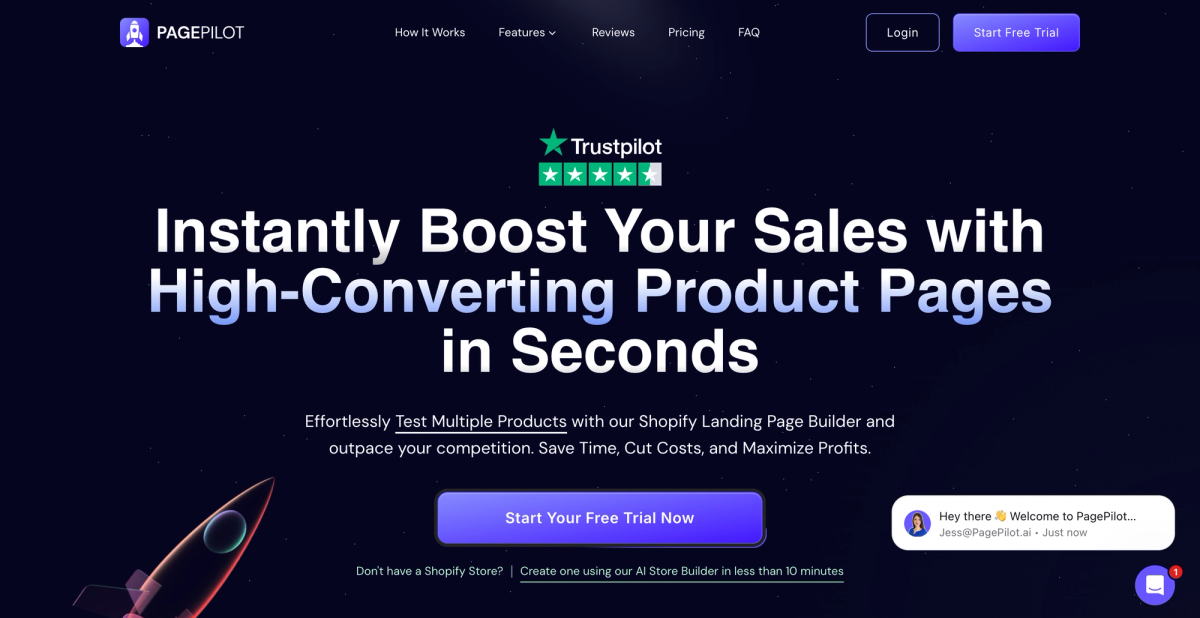
PagePilot is designed to help dropshippers rapidly test products and launch high-converting product pages with minimal effort. Its AI-powered page builder streamlines the process of setting up product listings, reducing the time it takes to move from idea to live store.
Key Features of PagePilot
- AI Page Builder: Simply input a competitor or supplier URL, and PagePilot will generate a polished product page based on the available information, optimising layout and copy for conversions.
- AI Product Image Enhancement: The platform upgrades your product visuals, ensuring you stand out with fresh, high-quality images rather than relying on generic supplier assets.
- Fast Testing: By automating page creation and image updates, PagePilot allows sellers to test multiple product ideas and marketing angles quickly, improving their ability to identify winning products.
Ideal For
PagePilot is particularly useful for dropshippers who need to validate products fast without investing heavily in custom design or copywriting. It’s suited for early-stage ecommerce entrepreneurs looking to reduce setup time while maintaining professional branding and presentation.
Free Trial
PagePilot offers a free trial, allowing you to create up to three product pages at no cost (no credit card required), making it easy to explore its capabilities before committing.
2. Shopify: The Best Dropshipping Software Overall
Shopify is the largest e-commerce builder platform. With a comprehensive online store package and numerous other dropshipping integration tools, Shopify is a great solution to get your online shop up and running.
Features
Shopify can be expensive, plus it’s more of a foundation to build up your online store than a dropshipping tool. Luckily, they offer a 3-day free trial, which is ideal for beginners just entering the dropshipping market.
Shopify Free Trial
The free trial runs for 3 days. During special occasions and promotions, they extend their plan for up to 30 days. So, checking their official website for the latest offers is best. Features available:
- The free trial is best for setting up your online store and exploring its features.
- You can access Shopify’s dashboard and online store set-up tools.
- You can add products, their descriptions, and design the store.
3. WooCommerce: The Free Dropshipping Plugin
Woocommerce is a free Plugin, unlike Shopify. If you have a running website on WordPress, you can turn it into an online store using WooCommerce without any upfront investment. Giving your store all the e-commerce capabilities with the free Plugin using WooCommerce is possible. It offers a wide range of customization options and adaptabilities that are free and grow with your business. Key features:
- The WooCommerce plugin is free. One needs to buy the domain and host, which can cost from $3 to $15 per month.
- Wide variety of plugins and themes to match your online store needs.
- It comes with many integrated tools like AliDropship and Spocket for better management.
- Allows you to start free and then scale up as the business grows.
- Supports multiple payment methods.
4. AliExpress Dropshipping Center: The Best Free Dropshipping Tool
The AliExpress Dropshipping Centre is the best free tool for product research and supply. You might not be using AliExpress for dropshipping, but their product research tool is free. If you want to up your game by finding never-before-seen products in your dropshipping store, the Dropshipping Centre is what you need. Key features:
- Uses data-driven insights for product analysis to ensure they align with your business goals and targets.
- It can assess the suppliers’ integrity by checking the suppliers’ reviews, pricing, product quality, and customer service.
- The product-finding tools find niche products or trending products by using AI recommendations and filters.
- Helps monitor sales metrics like revenue, conversion rates, and customer retention to improve inventory and market strategies.
5. Google Trends: The Free Tool for Dropshipping Market Research
Google Trends has always been the best free tool for any keyword research. This applies to dropshipping marketing as well. With Google Trends, you can analyze keywords based on their popularity and compare them to others. Using geo-location, one can use Google Trends to explore different topics and see if they are popular in the targeted area. Key features:
- Google Trends allows you to search for a topic of interest over time. You can see the results from 2004 tothe present.
- The geo-location filter will help you perform location-based topic research. With this, you can see the demand for a product in your targeted area.
- The free tool also lets you compare short-tail and long-tail keywords.
- It shows the trending searches in your area. You can change the location to see other trending topics in the new location.
6. Google Ads Keyword Planner: The Free Tool for Targeting Dropshipping Keywords
Google Ads is another very effective tool. It helps you create a strong base of keyword lists to attract the right customers. It can help you find high-intent keywords and their search volume to drive more traffic to sales. It can give you a clear idea of the cost of the targeted keywords. You can generate more keyword concepts, estimate bids, and create a budget using a keyword planner in Google Ads without any upfront cost. Key features:
- Provide a list of potential keywords based on your search.
- This shows the search volume of the keywords per month and the competition for the keywords.
- It can help you refine search results based on parameters like search volume and competition.
- I will give you an estimate of the cost to bid on a specific keyword for Google Ads.
- It can show years of search results to identify seasonal or long-term trends.
- You can target your location to explore trends in a particular region.
- Helps in better campaign organization by providing an overview of competitors in the market, targeting the exact keywords.
7. DeepSeek: A New AI Tool for Dropshipping
DeepSeek is an AI company founded in 2023 to create ‘General Artificial Intelligence’ (AGI). DeepSeek focuses on developing state-of-the-art AI technologies, especially “Natural Language Processing” (NLP) and “Deep Learning”, AI technologies that allow machines to understand human language, generate text, have conversations, and even solve more complex problems, such as:
- Chatbots
- Text generation
- Language translation
- Organizing
8. ChatGPT: The Free AI Tool for Dropshipping Content Creation
GPT or ChatGPT can easily create product descriptions and titles to optimize the search results. GPT can provide you with a list of attractive titles for your products, and it does it efficiently. The free version of GPT can generate an in-depth and optimized product description for your dropshipping store. It’s beginner-friendly, and you don’t have to spend a dime on writing descriptions, making it the best free dropshipping tool for content creation. Key features:
- Generates SEO-friendly titles and descriptions to attract potential buyers to your page.
- Creates comprehensive and compelling product description that highlights key features and benefits to attract buyers and increase sales.
- Can help you with content ideas related to product promotion, seasonal sales, and niche topics.
- Can create attractive blogs for your website to drive traffic to your page and boost credibility.
- It can adapt to the tone of your brand to better target your audience.
- Can write personalized emails for online campaigns.
9. Grammarly: The Free Writing Tool for Dropshipping Business
Dropshippers mainly use Grammarly to check grammatical errors, spelling, plagiarism, and paraphrasing. A free version of Grammarly is available to cater to your business, and it’s beginner-friendly. Grammarly makes checking all the text in their app or with browser extensions easier and supports all devices. Key features:
- Grammarly free tool helps you identify and rectify basic writing errors.
- It also fixes common punctuation errors.
- It improves sentence structure for better clarity and enhances readability.
- It can help improve the tone of writing to sound professional.
- Grammarly works with web browsers for a seamless editing experience.
10. DeepL: The Best Free Translator for Dropshipping
DeepL’s free version is the best free translator tool for dropshippers. DeepL is a comprehensive translation tool that supports multiple languages and translates texts without changing the nuance or the meaning. It can help you grow your business internationally without any upfront cost. Key features:
- DeepL translations are contextually correct, which means they keep the original context and make product descriptions and titles clear and professional.
- Even the free version supports multiple languages, allowing you to reach the global market.
- It can translate texts, images, files, and speech.
- It gives free writing suggestions in 4 languages: English, French, German, and Spanish.
- Once your business gets up and running, you can upgrade to any of the three paid plans, which are starter, advanced, and ultimate, according to your business growth and plan.
11. Google Translate: The Most Popular Translation Tool
Google Translate is the most popular translation tool. It supports more languages than DeepL and is the easiest to use. If you are new to the dropshipping business, Google Translate is the best translator tool for you. It can translate the entire webpage so that you can display multilingual customer reviews on your website. It’s time-consuming to translate, and the results are not contextually correct. Key features:
- It’s free of cost and without any limit on characters.
- The only free translation tool that supports over 100 languages.
- It can translate in both text and voice, which makes communication with customers easy.
- To translate from images, you need to download the mobile app.
- It allows you to download languages for offline-mode translations.
12. Canva: The Free Graphic Design Tool for Dropshipping
Canva is the most preferred graphic design tool. Canva is a comprehensive editing and graphic design tool, not just limited to creating product images. People use Canva to create engaging product videos, social media posts, and presentations to attract potential buyers.Key features:
- Canva gives access to thousands of free templates and more than 3M graphic elements, such as creating engaging product images, social media posts, and video representations.
- It’s a drag-and-drop editor, which means it has a simple interface and is beginner-friendly.
- You can add and customize text size, fonts, and colours.
- It allows you to add other members and collaborate with them.
- Provides 3GB of cloud storage to upload and save your logos, photos, and previous designs.
- It lets you download in various formats like PNG, JPG, and PDF.
13. TingPNG: The Best Free Image Compressor for Dropshipping
Regarding image compressors, TingPNG offers a reliable and handy solution for dropshippers. The free image compressor tools offer decent compression levels and allow 20 image uploads simultaneously, which is sufficient for a small-scale dropshipping business. Key features:
- TinyPNG reduces the file size without compromising the quality.
- The free tool is compatible with both PNG and JPEG image files
- It works with a simple drag-and-drop interface, making it easier to use
- The free version can compress 20 images at once
- Integration with WordPress and a few other platforms allows seamless use
- The web-based tools need no installation or download
14. Google Analytics: The Best Free Tool for Tracking Dropshipping Business Performance
Without insights into analytics, no business can grow, and this also applies to dropshipping. While too many tools can give you insights into current trends and traffic, the more crucial metrics can only be checked in Google Analytics. All the data you need to keep track of is available in your analytics dashboard for free. Key features:
- Can give complete traffic insights, including website visitors and sources.
- Analyze the time spent by visitors, page views, and bounce rates.
- Monitors sales and sign-ups.
- Give insights on customer demographics and preferences.
- Generates data-based reports on sales, revenues, and product performance.
- Gives live updates on on-site activity.
15. Google Search Console: The Best Free Tool for Dropshipping SEO
Unlike Google Analytics, Google Search Console gives you an outlook on how your store or website appears on Google and how people find it. It provides data-based information on clicks, your search position, click-through rates, and the keywords that drive traffic. It works on issues that reduce the search rankings and keeps track of pages indexed by Google. Key features:
- Keep track of clicks, page impressions, and keyword ranking of your page.
- It can identify and fix index issues.
- Monitors incoming links to your site.
- Performs URL inspection and checks individual page performance.
16. TikTok, Facebook Page, and Facebook Group: Free Marketing Tools for Dropshippers
Dropshippers can reach a larger audience using free drive traffic tools like TikTok, Facebook Page, and Facebook Groups. Dropshippers can think of new creative ideas to make videos showcasing products, depending on their targeted audience. Key features:
- TikTok offers massive organic reach through its algorithm. It’s a great place to create engaging content with viral potential, use hashtags, and share links that direct users to your site.
- Share diverse types of content on Facebook Pages, such as posts, live videos, and events, and place CTAs carefully to drive organic traffic.
- Facebook Groups can help you target niche audiences. Sharing direct links, polls, active discussions, and live videos will build trust and drive consistent traffic.
17. Dropshipman: Free Dropshipping Automation Software
Dropshippers looking for free dropshipping tools should consider Dropshipman. It’s a stop destination for product sourcing, logistics updates, and dropshipping fulfillment. The best part of this tool is that it integrates effortlessly with free dropship platforms like Shopify and WooCommerce, automating the entire process of order shipping, inventory updates, and order tracking. Key features:
- 5M+ trending products in Dropshipman Marketplace.
- Import products from Aliexpress and Temu.
- Works integrated with Shopify and TikTok Shop.
- Fulfill all your orders, including tracking info updates, product quality checks, etc.
- 24/7 sourcing agent and dedicated manager.
18. Trustoo Ali Reviews Importer: The Best Free Dropshipping Review Tool
Trustoo Ali is a review importer, which means it imports product reviews from AliExpress and makes them visible on your page, creating social proof for products. The free tool seamlessly integrates with Shopify and many other E-commerce sites. Key features:
- Seamlessly integrates with Shopify Apps and themes.
- Offers a wide range of customizable widgets and review translations.
- Equipped with a straightforward interface.
- Offers multiple language support and translations.
19. Kudosi Reviews – AI-Powered Review Automation
Best for: Dropshippers seeking instant, high-quality product reviews.Kudosi Reviews is an AI-powered app that helps dropshippers import and generate high-quality product reviews from AliExpress, Temu, eBay, and Amazon. With Kudosi, you can instantly add social proof to your store using stunning, customizable review widgets. This boosts trust, engagement, and conversions, helping you stand out in a competitive market.Key features:
- Import genuine reviews from top marketplaces.
- AI-generated reviews for missing products.
- Customizable review widgets to match your brand.
- One-click setup for seamless integration.
Related Reading
- How To Use AI For Dropshipping
- How To Set Up A Dropshipping Business
- How To Find Winning Products For Dropshipping
- How Much Can You Make Dropshipping
- Dropshipping Business Ideas
- Best High Ticket Dropshipping Products
How to Choose Dropshipping Software Based on Your Stage
The right dropshipping software depends on where your business is right now, not where you want it to be in a year. Beginners, growth-stage operators, and merchants scaling past 50 orders a day have fundamentally different needs, and choosing tools designed for a different stage either wastes money or creates bottlenecks. The framework below helps you match your tool selection to your actual operational reality.
Beginner (0 to 10 Orders Per Day)
At this stage, simplicity and low cost matter more than advanced features. You are still figuring out what products sell, which suppliers are reliable, and how your store performs with real traffic. The priority is getting products listed, running small ad tests, and processing orders without overcomplicating the workflow.
A basic Shopify plan, a free product research tool like Google Trends or the AliExpress Dropshipping Center, and a simple page builder or AI tool to create product pages quickly is usually enough. You do not need bulk order processing or multi-platform inventory sync when you are fulfilling a handful of orders a day. Save your budget for ad testing and product validation instead of stacking paid apps.
Growth Stage (10 to 50 Orders Per Day)
Once you are consistently processing orders, manual work starts eating into the time you need for product testing and marketing. This is the stage where automation tools become essential. You need inventory syncing so you stop overselling, automated order routing so you are not manually forwarding every order to your supplier, and better product pages so your conversion rate keeps up with increasing ad spend.
This is also where paid apps start earning their cost, because the time savings compound at higher volume. A premium theme, a solid fulfillment automation tool like Dropshipman, and a conversion-focused page builder are the core additions at this level.
Scaling Stage (50+ Orders Per Day)
At scale, the stakes change. A single inventory error or fulfillment delay affects dozens of customers instead of a few. You need multi-platform support if you are selling on Shopify, Amazon, or other channels. You need supplier diversification so a single stockout does not shut down your best-selling product. And you need advanced analytics to understand which products, suppliers, and marketing channels are actually profitable at volume.
At this stage, your software stack should function as an integrated system where data flows between tools automatically, and the tools you relied on as a beginner may need to be replaced with platforms built for higher throughput.
The table below maps each stage to its recommended focus areas.
The best dropshipping software depends on your stage. Beginners need simplicity, while scaling stores need automation and multi-platform integration.
What Actually Matters When Choosing Dropshipping Software
Most comparison content focuses on feature lists and pricing tables, which makes it easy to pick a tool based on what it can do without thinking about whether those features actually improve your business. The factors below are the ones that reliably separate tools that help you grow from tools that just add complexity to your workflow.
Automation level is the single biggest differentiator. A tool that automates order routing, inventory updates, and tracking saves you hours every week, and those hours compound as order volume grows. If a tool requires you to manually process each order or update stock levels by hand, it creates a ceiling on how fast you can scale before the workload becomes unsustainable.
Supplier quality matters more than supplier quantity. A platform that connects you to thousands of suppliers sounds impressive, but if most of those suppliers have inconsistent shipping times, poor packaging, or unreliable stock levels, the volume of options does not help you. What matters is whether the tool gives you access to vetted, reliable suppliers who can deliver consistent quality, especially if you are targeting US or EU customers who expect faster shipping.
Integration depth determines how much manual work sits between your tools. If your product research tool, your storefront, your fulfillment system, and your analytics platform all operate independently, you are spending time transferring data between them instead of acting on it. The best dropshipping software connects directly to your store and your suppliers so that information flows without manual handoffs.
Speed is what ties it all together. The faster you can research a product, list it, build a product page, and start running traffic, the more products you can test and the faster you find winners. Every tool in your stack should be evaluated by whether it accelerates or slows down that cycle.
Dropshipping software should be chosen based on automation, supplier quality, and integration, not just feature lists or pricing.
Common Mistakes When Choosing Dropshipping Software
Even experienced merchants make avoidable mistakes when building their software stack, and those mistakes usually cost more in wasted time than in wasted money. The patterns below show up again and again in dropshipping businesses that struggle to scale, so spotting them early can save you months of frustration and help you build a stack that actually supports growth.
Using Too Many Disconnected Tools
This is the most common mistake because it’s easy to sign up for a new app every time a specific problem shows up. But when your research tool, supplier platform, fulfillment system, and page builder all run separately, you end up spending more time managing software than running the business.
A smaller stack of tools that work well together will usually outperform a larger collection of disconnected ones. The goal isn’t to use more software. It’s to build a workflow where each tool has a clear job and connects cleanly to the rest of the system.
Choosing the Cheapest Option Instead of the Most Scalable One
Low-cost tools make sense when you’re starting out and validating products, but they can become expensive in a different way once they start slowing you down. If a cheaper tool creates bottlenecks, adds manual work, or can’t support the next stage of the business, the lost efficiency usually costs more than the upgrade would have.
That’s why software decisions should be tied to business stage rather than price alone. The right tool isn’t always the cheapest one. It’s the one that fits what the business needs now without creating obvious problems later.
Ignoring Supplier Quality
This mistake compounds over time because supplier issues rarely stay contained to one order. Many merchants focus on product margins and shipping cost, but overlook consistency, packaging quality, and communication speed, even though those things have a direct effect on refunds, chargebacks, and customer satisfaction.
A supplier who saves you a small amount per unit can still end up costing far more if orders arrive late or quality is inconsistent. What looks cheaper on paper often becomes more expensive once support issues and lost repeat purchases start piling up.
Not Planning for Scale
Some tools work perfectly well at ten orders a day, but start breaking once volume increases, and that is where growth-stage merchants often get caught off guard. If your workflow starts failing right when the business needs to move faster, you end up rebuilding systems at the worst possible time.
That’s why it helps to evaluate tools against future volume, not just current volume. Before committing long term, it’s worth asking whether the software can handle two to five times your current order flow without forcing a full operational reset.
Choosing Software Based on Price or Features Alone
The biggest mistake is judging dropshipping software by price or feature count without asking how well it supports automation, speed, and scale. A tool can look impressive on paper and still be the wrong fit if it adds friction, slows execution, or makes the business harder to run as volume grows.
How to Choose the Right Dropshipping Software for Your Business

Before you start comparing dropshipping software, take time to identify your business’s requirements. Are you just starting or scaling an existing store? Do you plan to sell through Shopify, WooCommerce, Amazon, or a mix of platforms? Knowing your volume of orders, product niches, and preferred suppliers helps you filter software options based on real needs, not hype.
Look for Seamless Integration with E-Commerce Platforms
The best dropshipping software integrates seamlessly with your online store. Common platforms like Shopify, WooCommerce, BigCommerce, and Wix provide varied levels of integration support. Choose software that connects directly to your store, allowing for automated order fulfillment, inventory syncing, and pricing updates. This reduces manual work and minimizes the risk of errors.
Choose Software with Reliable Supplier Networks
Good dropshipping software gives you access to a vast network of reliable suppliers. Look for platforms that provide curated product databases, supplier rankings, and automatic stock management. Tools like Spocket, DSers, and Syncee specialize in connecting customers with high-quality suppliers from the US, EU, and Asia. If you’re targeting a specific region or product type, make sure the software supports it.
Find Tools that Automate Your Dropshipping Business
Automation is one of the most significant advantages of utilizing dropshipping software. Evaluate how much of the process the tool can automate, from product imports and stock updates to order routing and tracking numbers. Options like bulk product uploads, auto-ordering, dynamic pricing, and branded invoicing can save hours and improve efficiency.
Understand Pricing Plans and Long-Term Costs
Dropshipping software usually comes with tiered pricing models based on features or order volume. Look for a platform that aligns with your current budget but may scale with your business. Some software offers a free plan with limited features, perfect for testing, while others require monthly fees. Don't just go for the cheapest option; consider long-term value and scalability.
Check Customer Support and Training Resources
Responsive customer support can be a game-changer when technical issues arise. Check if the software provider offers live chat, email support, or a knowledge base. Some platforms also provide video tutorials, onboarding sessions, and webinars to help you get started quickly. User communities and forums can also be valuable sources of advice and troubleshooting.
Evaluate Software Performance and Speed
Dropshipping tools that lag or crash during high-traffic periods can seriously damage your operations. Select a platform known for stability, fast syncing, and uptime. Read reviews from other users about software performance and look for demos to test it before committing.
Select Software With Strong Analytics and Reporting
Data-driven decisions are crucial in e-commerce. Select software that provides strong analytics tools to help track sales performance, best-selling products, shipping times, and customer behavior. This insight enables you to optimize pricing, inventory, and marketing strategies.
Choose Software That’s Easy to Use
Ease of use matters, especially if you’re managing everything yourself. The software should offer an intuitive dashboard, easy navigation, and clear instructions. A steep learning curve can slow down your progress, so prioritize software with a clean interface and good user feedback.
Research Security and Compliance Features
Your dropshipping software should adhere to standard data security practices. It must be GDPR-compliant if you operate in Europe and should protect customer information. Check whether the software uses secure payment methods and data encryption to safeguard your business.
AI Tool to Instantly Build High-Converting Product Pages
Our AI Page Builder will help you test products/ideas and angles way faster than before. Just give our AI a competitor/supplier URL, and we will be able to create a high-converting product page using the information found on their website. Using our AI Product Image function, we will also upgrade the visuals of the product, so you're not competing with the same copywriting/ product images as your competitor. Start a FREE Trial and generate 3 product pages for free today (no credit card needed).
How Dropshipping Software Improves Efficiency

Running a dropshipping business without software can be exhausting. Manually checking inventory, updating product listings, and processing orders can take up valuable time. Dropshipping software automates these tasks, freeing up your schedule to focus on marketing and scaling your business.
Accuracy and Reliability: Improve Your Store’s Performance Metrics
Mistakes like overselling, incorrect pricing, or delayed orders can harm your reputation. Dropshipping software minimizes these errors by keeping everything up-to-date automatically. This accuracy ensures smooth operations and happy customers.
Scalability: Manage Growth Without the Growing Pains
As your business grows, so do the challenges. Dropshipping software allows you to manage more products, suppliers, and orders without additional manual effort. It scales with your business, making growth more manageable.
Improved Customer Experience: Keep Shoppers Coming Back
A seamless shopping experience is key to retaining customers. Dropshipping software ensures customers get accurate product information, timely updates, and reliable delivery. Satisfied customers are more likely to return and recommend your store to others.
Competitive Advantage: Stay Ahead of the Competition
The e-commerce industry is highly competitive. By leveraging dropshipping software, you can offer faster processing times, better product availability, and competitive pricing. These advantages set you apart from competitors who still rely on manual processes.
Related Reading
- Dropshipping Products With High Profit Margin
- AI Tools For Dropshipping
- Best Dropshipping Products
- Gempages Vs Pagefly
- Shogun Vs Pagefly
Start a FREE Trial and Generate 3 Product Pages with Our AI Page Builder Today
PagePilot is an AI dropshipping app that can help you create product pages faster than ever. Their software analyzes your competitors to help you create high-converting product pages that compete with the best. Just give PagePilot a competitor or supplier URL, and their AI will instantly create a product page using the information found on that website. This includes rewriting the copy to make it unique, so you're not competing with the exact copy as your competitor. The AI will also upgrade the visuals of the product, so you're not competing with the same product images as your competitor, either. Start a free trial of PagePilot today and generate three product pages for free with no credit card needed.
Build a Smarter Dropshipping Software Stack With PagePilot
Dropshipping software is not a single tool you install and forget. It is a system of connected tools that handle different parts of your operation, from finding products and sourcing suppliers to automating fulfillment and converting visitors into buyers. The merchants who build that system intentionally, choosing tools that integrate well and match their current stage, consistently outperform those who stack apps without a clear plan.
The most important lesson in choosing dropshipping software is that simplicity and integration matter more than feature counts. A lean stack of three or four tools that work together smoothly will always beat a bloated collection of disconnected apps that each solve one narrow problem. Start with the basics, automate the repetitive work as volume grows, and invest in the tools that directly affect how fast you can test products and how well your pages convert.
Speed is the underlying advantage that ties everything together. The faster you can move from product idea to live page to traffic test, the less money you waste on products that do not sell and the more quickly you find the ones that do. Every tool in your stack should be evaluated by that standard: does it help you test faster, sell better, or operate more efficiently? If the answer is not clear, the tool is not earning its place.
If you want to see how fast you can move from product idea to live, tested product page, try PagePilot free and generate your first three pages in minutes with no credit card required.